By Laura Diederich, Stephanie Macejko, Corrie McDermott and Jocelyn Cote
Through the years, Breyer models have come in a variety of sizes and shapes, and so have their packaging. While most modern boxes add little value to a model, certain packaging, especially short-lived vintage styles, can make a "run-of-the-mill" model into a highly sought-after collector's piece. While not totally exhaustive, this article will take you through a tour of the different packaging Breyer models have come in through the company's 75+ year history.
The first box style for Breyer models was a plain white shipping box with a space for a mailing address. The Breyer company name and address was stamped on the side along with the model's name and number. This style of box was used in the 1950s and 1960s. The store merchants would take the model out of the box and display the model on the store shelf, and the blue ribbon sticker on the model would indicate its item number. When the model was sold, the salesperson would then provide the customer with the original box.
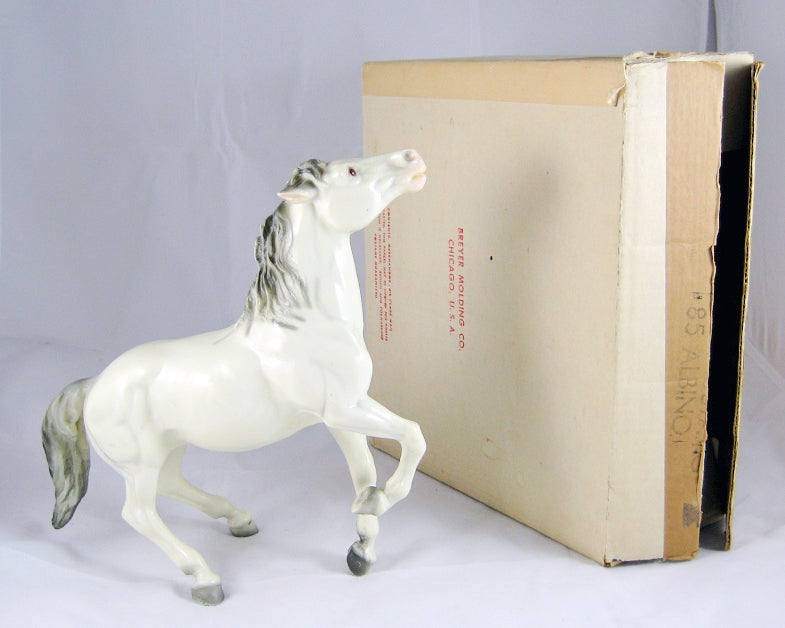
#85 Mustang with original white shipping box
© Sara Roche
In the late 1960's, Breyer used a white framed box style called a "display carton," more commonly referred to by collectors as the "touchability box." These boxes had a decorative printed border, with the Breyer name in bold lettering on the box's side. The model was attached inside the box with an elastic string. A 1969 sell sheet noted that this package incorporated "the advantages of visual display while maintaining the unique aspect of touch-ability inherent in the quality of a Breyer Animal Creation." These boxes allowed shoppers new to the brand to feel the quality of the model’s material. However, without the full window in front, the packaging did not consistently ship well without damaged corners (among a multitude of other reasons) and was discontinued. This style of box made a brief, full-color return for the "My Favorite Horse" series in the early 2010s, but was also discontinued.
|
Display carton/"touchability box" packaging, 1969
|
"My Favorite Horse" packaging, 2009
|
In the 1970s, the next generation of packaging was called the Showcase Collection, which housed regular run models in clear plastic carrying cases. Available from 1970-1972, these boxes fully displayed the model on all sides. The models contained in these special cases were given unique item numbers. Breyer wanted very much to show off their beautiful models! Like the display cartons, however, they were quickly discontinued because although the design was beautiful, it wasn't quite practical.
Alongside the Showcase Collection, Breyer also used a fully-closed white cardboard box with a full-color photo of the model inside. This photo was displayed on a color background with original pen-and-ink sketches unique to each breed – for example, the Family Arabian Mare's box had dressed Bedouin Arabian horse and rider illustrations. The model's name was printed with bold black lettering on the front of the box. Later in the decade, the white box with colored backdrop was replaced with a brown, tan and gold background and fresh logo, but retained the model picture and bold black lettering. Gift sets were packaged in heavier cardboard boxes with a plastic carry handle.

Gift set and "showcase" packaging from 1972 dealer catalog
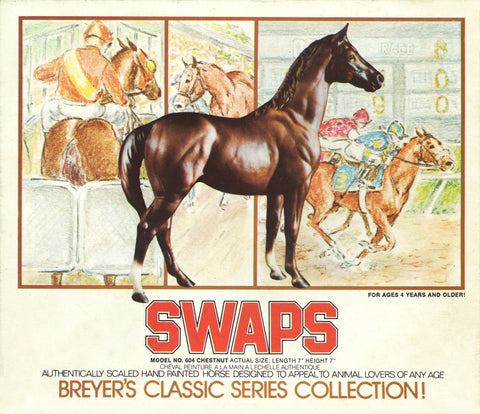
In 1975, the Classics Thoroughbred racehorses were introduced and packaged in custom cardboard boxes. The boxes were white with a photo of the model inside, as well as full color drawings of the horse. The model’s name was written in bold red type. Also that year, the new smaller Stablemates series horses were sold on black colored blister cards.
During this time, Classics scale foals sold separately from the family sets were sold on blister cards in yellow, pale green or orange with "Breyer" in white letters and the Breyer Animal Creations logo visible beneath the foal through the packaging.

1970s picture boxes
Jumping forward to the late 1970s, Breyer experimented with a new type of box. This style had four sides and a back with brown, tan and gold accents, but the front of the package displayed the horse in a hard shrink-wrapped plastic casing. The presentation was similar to that of the display cartons from a decade earlier. Although well-suited for display purposes, this design was difficult to open and was only used for a short time. Models still sealed in these boxes are now highly sought-after collector's pieces.

Short-lived blister/shrink wrap box, circa late 1970s
Photo by Sheryl Leisure
A photograph of the horse against a gradation of black to gold background color graced the next closed-style box. Bright yellow letters, a new font, and a contemporary look brought the packaging into the early '80s. Horses or sets sold by catalog companies during the 1980s were often packaged in the white cardboard boxes with a photo of the model(s) inside gracing the front of the box.
New Little Bits (1:24 scale) models were sold on blister cards when they were released in 1984. The card was a golden yellow on the bottom with a photo of a girl and a bay horse gracing the top.

Promotional image with typical early 1980s packaging
After Breyer became a division of Reeves International in 1984, the packaging was updated so that the detailed models inside could be seen easily on the store shelf. Creating a window box for so many styles of horses – some with heads turned this way or that, or tails flipped, or a wide stance – made making a single style of package for the entire line a challenge. Furthermore, the slightly top-heaviness of a model horse, coupled with an average weight of about 12 ounces, further complicated the effort to ensure that the horses remained securely and beautifully in place during shipment to stores. Zip ties were required to hold the horses in place, and later a film laminate proved necessary to cover the internal printing to ensure that the ink did not rub off on the horses. After months of development, the final result was a sturdy window box with yellow as the dominant color, accented by the blue and gold Breyer logo and blue and red striping on the panels. This was the beginning of the iconic yellow Breyer box that is so recognizable today!
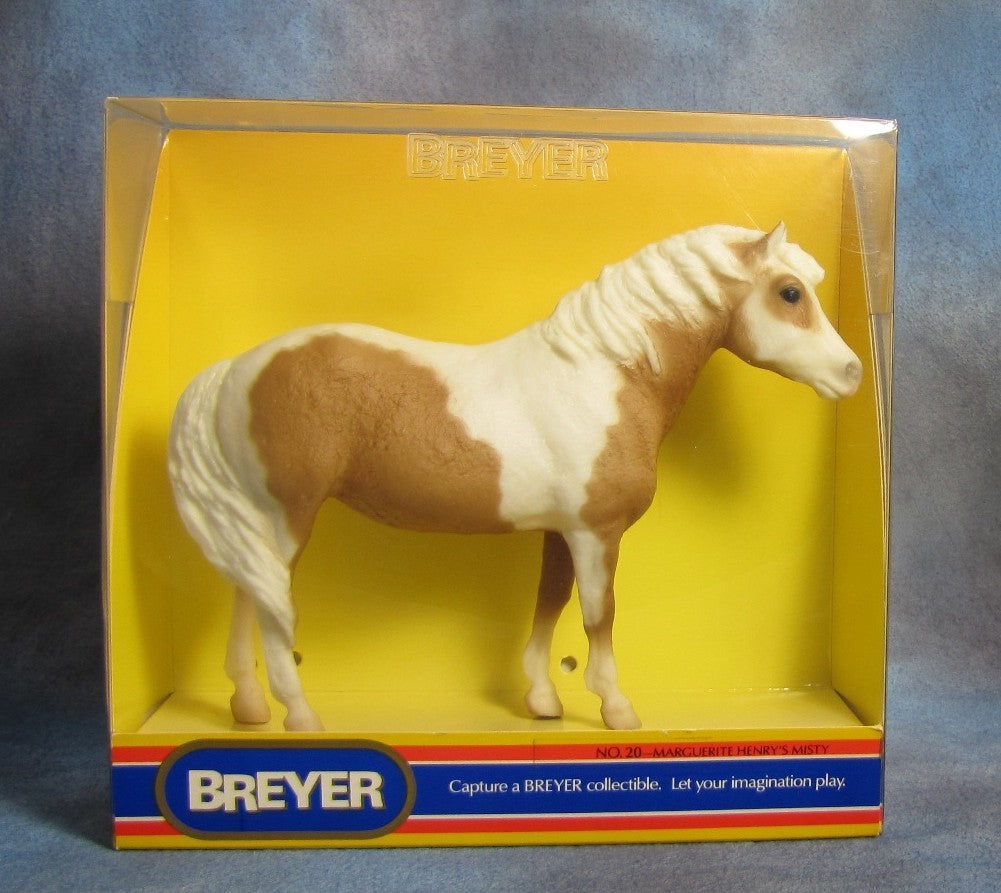
First generation window box, circa late 1980s
This new color scheme carried over to other lines as well. For example, Classics horse sets were packaged in yellow cardboard boxes with a blue and red stripe and the Breyer logo, with a gold-colored plastic handle for carrying. The 1990s saw similar packaging to that of the late 1980s for Traditional models, with the exception of the late 1990s when some of the models were presented with scenic and decorative full-color printed backgrounds in their boxes instead of the generic yellow color.
Rust-colored packaging with a red stripe at the top and the Breyer logo were introduced for dolls, saddles, jumps and other accessories in 1992. This color packaging was short-lived, and in 1995 yellow packaging with a red and blue rosette and the Breyer logo took over. Little Bits models were rebranded as the Saddle Club series, and were sold in yellow boxes with Saddle Club and Breyer logos. Stablemates packaging looked similar to that of the Traditional and Classics sets – a yellow blister card with red and blue stripes and the Breyer logo.
The turn of the century offered many new and unique styles of Breyer packaging. Most Traditional-scale models, both regular and special run, featured eye-catching photos of scenery or real horses on the back panel, surrounded by the iconic yellow box with blue Breyer logo. The plastic zip ties that held the models to the background were replaced with plastic-coated metal twist ties for easier removal. Regular run Classics horses had similar packaging on a smaller scale - yellow boxes with a white fence design on the outside of the plastic and a stall background.
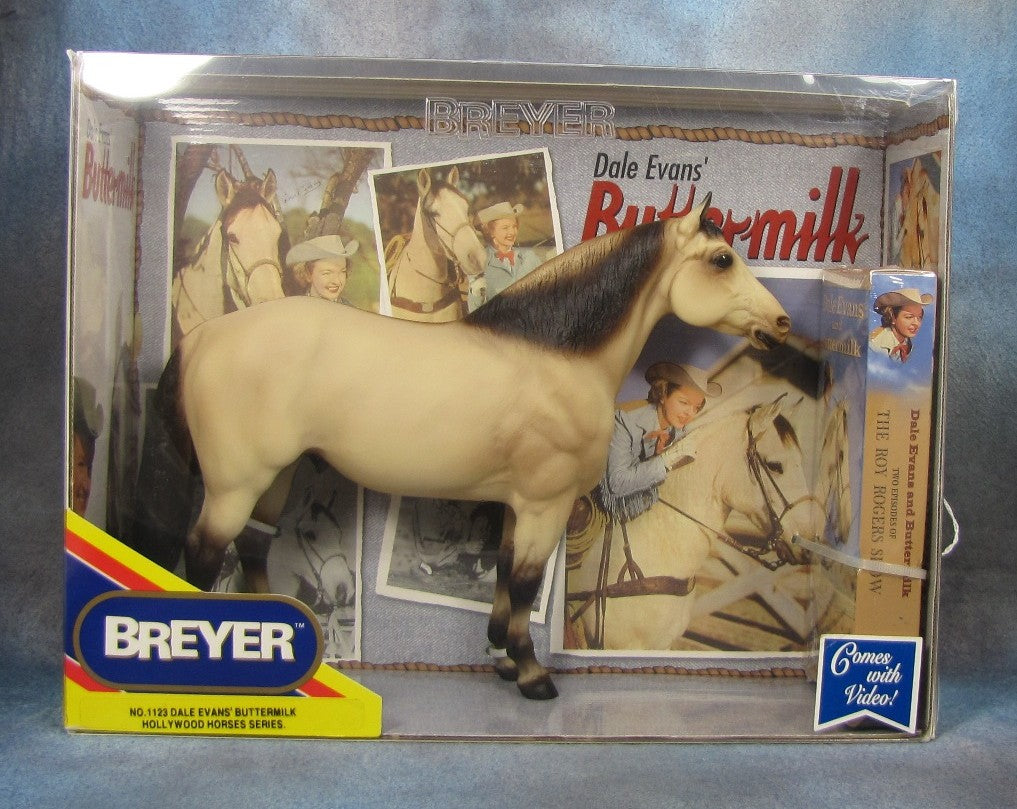
#1123 Dale Evans' Buttermilk, an early example of a model with a full-color printed background
Most smaller models were released as blister-carded singles on cardboard. The Saddle Club Series, formerly Little Bits, was rebranded once again as Paddock Pals, featuring a unique barn design for the card. Stablemates single horses were released on a card in the shape of a rosette. Other lines released on blister cards were Breyer Ponies, a relaunch of the "Dapples" series from the late 1990s, and the Companion Animals series.
Some special run Stablemates sets in the early 2000s came in blue hat-box style packaging, featuring textured paper, fancy gold lettering embossed on the outside lid, and black flocked plastic in the shape of the models to hold them inside of the box. Some of these sets included the QVC Silver Cup Series and the JAH Fanfare Stablemates. Similar packaging has since been used for BreyerFest commemorative Stablemates released at BreyerFest 2009 and 2019.
During this era, it became more common to purchase special run models directly from Breyer. Many of these models ship in white mail-order boxes with blue horses running across the box. (A few different designs have graced their sides over the years, but the concept remains the same.) Some examples of these models are the Connoisseur series, Just About Horses special runs, and Web Specials.
As the first decade of the 2000s drew to an end, new color schemes emerged, such as purple Paddock Pals blister cards and pink cards for the "Pony Gals" Stablemates line. A light tan box for Traditionals was also trialed in the early 2010s, but was soon reverted back to the iconic yellow and blue color scheme. Special packaging is often created for events, retail stores and special editions such as the annual Breyer Holiday lineup. A unique graphic treatment is also used for Hollywood licenses such as Spirit or Flicka, and big events such as the World Equestrian Games.

Branded Stablemates shadowbox for the 2010 World Equestrian Games
Photo by Kelly Weimer
Today, the iconic yellow and blue color scheme continues to be featured prominently throughout all Breyer lines. Current Traditional packaging, for example, features a soft gradient background inside of a yellow box with silver foil-stamped accents. As the years have gone on, these boxes have been designed to use less paper and plastic for more sustainability. Breyer packaging continues to evolve and change, keeping the models safe and the design eye-catching for collectors.
Traditional packaging design that debuted with 2021 new releases